

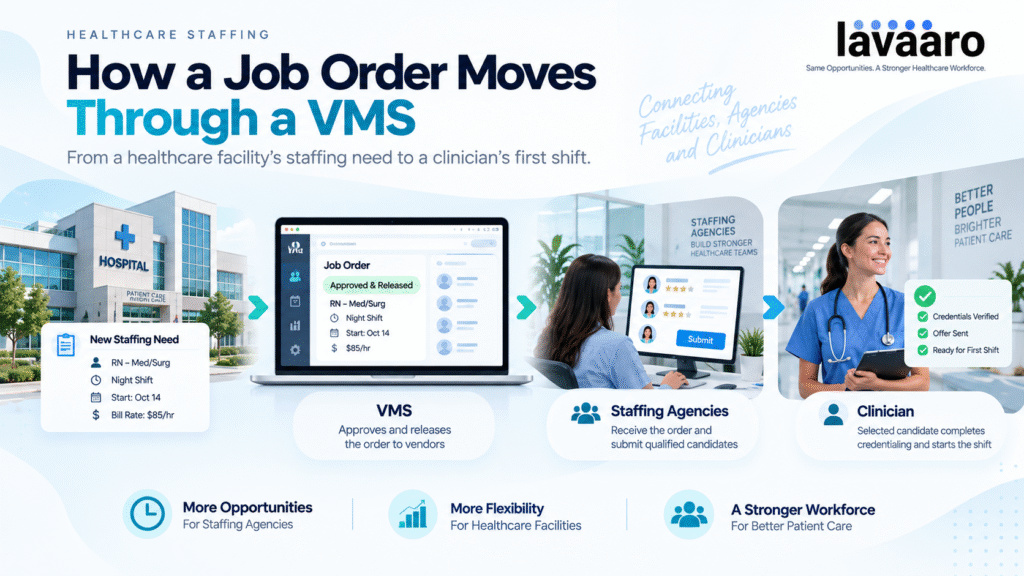
A vendor management system (VMS) is the software layer between a hospital’s staffing need and the agencies competing to fill it. In most VMS programs, a job order doesn’t go to every agency at once, it’s released in tiers, on a timer, and agencies who don’t understand that sequence lose orders they were fully capable of filling.
This is the operational reality agencies deal with every day, whether they’re on ShiftWise, LotusOne, Intellify, or a smaller regional VMS: how the order moves matters as much as who’s qualified to fill it.
Pro tip for staffing agencies: Before you evaluate whether you can fill an order, find out where you sit in that program’s release sequence. That single fact predicts more about your win rate than your candidate pipeline does.
How does a job order move through a healthcare VMS?
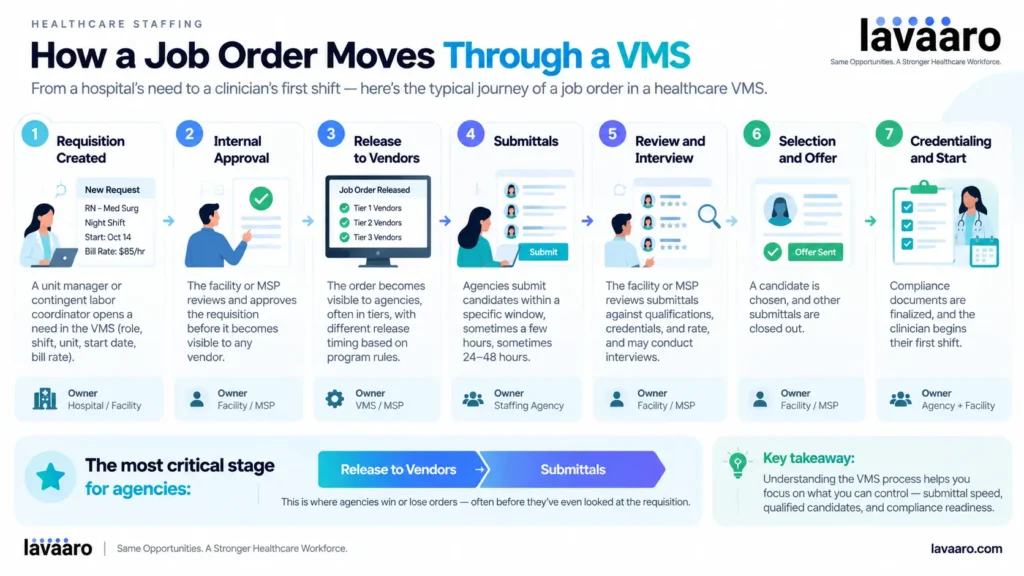
A typical order follows this path:
- Requisition created: a unit manager or contingent labor coordinator opens a need in the VMS (role, shift, unit, start date, bill rate).
- Internal approval: the facility or MSP approves the requisition before it’s visible to any vendor.
- Release to vendors: the order becomes visible to agencies, often in tiers (see below).
- Submittals: agencies submit candidates within a window, sometimes a few hours, sometimes 24-48 hours.
- Review and interview: the facility or MSP reviews submittals against qualifications, credentials, and rate.
- Selection and offer: a candidate is chosen; other submittals are closed out.
- Credentialing and start: compliance documents are finalized before the clinician’s first shift.
Every step between release and submittal is where agencies win or lose orders, often before they’ve even looked at the requisition.
What is tiering, and why does it decide who sees the order first?
Most MSP-run VMS programs group vendors into tiers based on past performance, contract terms, or relationship history. Tier 1 vendors typically see the order first, often with a head start of several hours to a full day. Tier 2 and beyond see it only after that window closes, sometimes after the best candidates are already submitted elsewhere.
This is the single biggest reason smaller or newer agencies feel locked out of a program even when they’re technically an approved vendor. Being on the vendor list and being in position to compete are two different things.
Common mistake agencies make in VMS programs: Assuming that vendor approval is the finish line. Approval gets you a login. Tier placement gets you the order.
Why does the release window matter more than qualification?
A facility isn’t choosing the “best possible” candidate from the full market, it’s choosing the best candidate submitted within the window it’s actually reviewing. If your agency has a qualified nurse but submits four hours after the tier 1 window opened, you may be competing against candidates who were already reviewed and shortlisted.
This is why submittal speed functions as a qualification criterion in practice, even though it’s rarely written into the contract that way.
| Stage | Typical tier 1 timing | Typical tier 2+ timing |
|---|---|---|
| Order released | Immediately | Delayed, after the program’s defined release window closes |
| Submittal window | Full window | Remaining time after tier 1 window closes |
| Practical effect | Full candidate pool considered | Often reviewing whoever wasn’t already selected |
How does a vendor-neutral marketplace change this sequence?
A vendor-neutral platform removes the tiering logic that favors one supplier group over another. Every approved agency sees the same order at the same time, with the same submittal window. This doesn’t guarantee every agency wins the order, qualification, rate, and speed still matter, but it removes the structural head start that tiering builds in.
This is the specific problem Lavaaro is built around: a marketplace where facilities and agencies collaborate on hard-to-fill shifts without one group getting first look by default. It doesn’t replace the discipline agencies need around submittal speed and compliance readiness, it just makes sure that discipline is what decides the outcome, not tier placement.
Key takeaway for agency owners: A vendor-neutral structure raises the ceiling on what a well-run agency can win. It doesn’t lower the bar on execution.
What should agencies fix on their own side, regardless of the VMS?
Even with equal access, agencies that win consistently tend to do a few things well:
- Pre-qualify a bench of clinicians before orders open, so submittal isn’t the first time credentials are checked
- Track win/loss by program to see which VMS programs are actually worth the recruiter time
- Assign one person to own submittal speed during business-critical hours, rather than treating it as whoever’s free
- Keep compliance documents current so a strong candidate isn’t disqualified on paperwork after being submitted
What usually breaks when contingent labor programs scale: Agencies that win one or two orders manually often can’t repeat it across multiple VMS logins without a defined process. The bottleneck shifts from “can we fill this” to “did we even see this order in time.”
How should a new agency decide which VMS programs to prioritize first?
Not every program is worth the same investment of time. Before applying broadly, a new agency should look at:
- Specialty fit: does the program’s typical order mix match what your bench actually covers well?
- Geographic overlap: programs tied to facilities far outside your service area rarely produce placements worth the ongoing monitoring effort
- Disclosed tiering practices: a program willing to explain its release structure up front is generally easier to plan around than one that treats it as opaque
- Realistic entry point: some programs are effectively closed to new vendors in certain categories; others actively recruit new agencies to fill specific gaps
Pro tip for staffing agencies: Rather than applying to every program you can find, start with three to five that best match your specialty and geography, and measure your actual order visibility and fill rate on those before expanding further. A wide, thin spread across a dozen programs usually produces worse results than focused effort on a handful that fit.
FAQ
1. Does every healthcare VMS use tiering?
No. Tiering is common in MSP-run programs but not universal. Vendor-neutral platforms are specifically designed to release orders to all approved vendors at the same time.
2. How do I find out if I’m tier 1 or tier 2 in a program I’m already on?
Ask your VMS or MSP program contact directly for your vendor tier and the release delay for lower tiers. This is not always disclosed proactively.
3. Can a new agency ever get to tier 1?
Usually yes, but it typically requires a track record, fill rate, submittal speed, and compliance accuracy, built up over several cycles on tier 2.
4. Is a vendor-neutral marketplace the same as a vendor-neutral MSP?
No. A vendor-neutral MSP still manages the program on behalf of a facility, without favoring an affiliated agency. A vendor-neutral marketplace, like Lavaaro, connects facilities and agencies directly without operating as either party’s MSP.
5. Does order volume vary a lot between programs, even within the same specialty?
Yes, significantly. Two programs covering the same specialty and region can produce very different order volumes depending on the facility’s contingent labor spend, how many other vendors are already active, and how the program routes orders internally, this is another reason to track your own results per program rather than assuming similar programs will perform similarly.
Key takeaway
Winning more healthcare staffing orders isn’t only about qualified candidates, it’s about where you sit in the release sequence for each program you’re on. Map your current programs by tier, fix your submittal speed on the ones worth keeping, and look at where an open marketplace could put your agency on equal footing from day one.
See open opportunities on Lavaaro, or if you’re a facility trying to widen the pool of agencies competing for your hardest shifts, post a role on Lavaaro.