
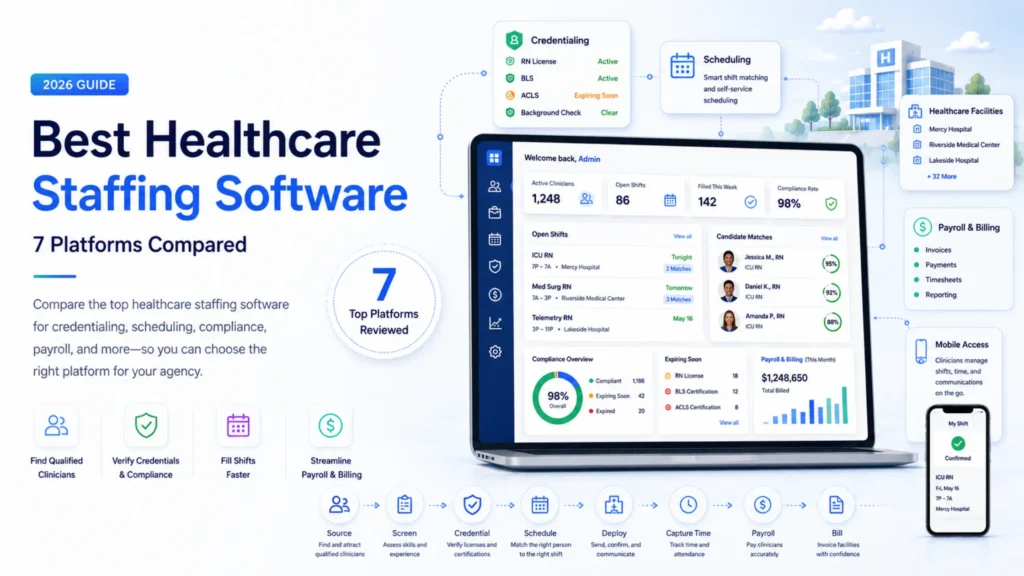
Healthcare staffing agencies run on three things: how fast they can source and credential candidates, how reliably they can fill shifts, and how cleanly they can bill for the work once it’s done. The right software touches all three. This guide compares seven platforms built for healthcare staffing, with real trade-offs for each, so you can match a platform to your agency’s actual workflow instead of a features list.
What makes staffing software “healthcare” software?
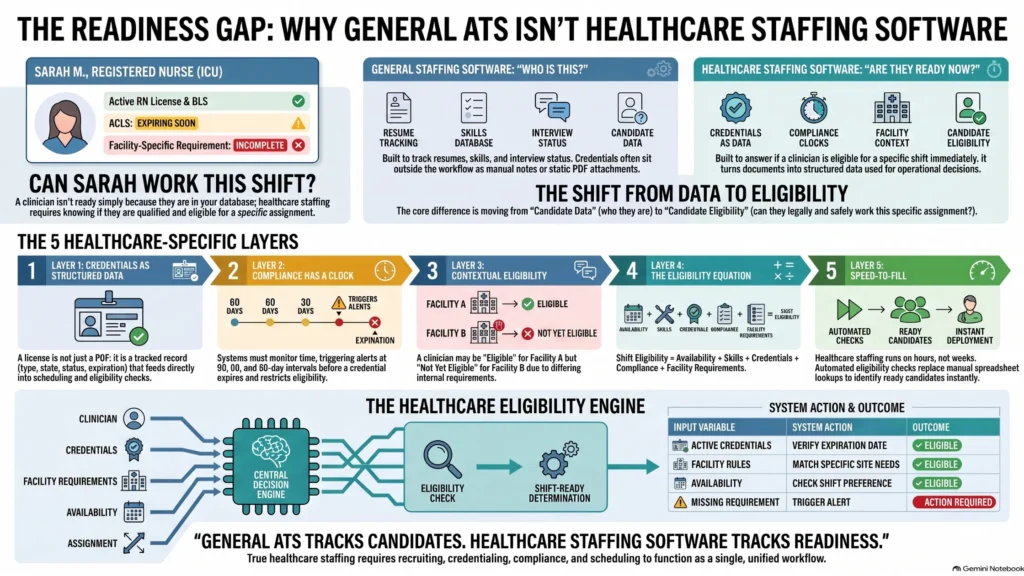
A lot of general staffing platforms are healthcare-adjacent rather than healthcare-built. The difference shows up in a few specific places: license and certification tracking as a native data type rather than a custom field, automated expiration alerts tied to state-specific renewal cycles, and hiring workflows fast enough for 24-72 hour shift-based placements. A platform missing that layer is a general ATS wearing a healthcare label.
Quick comparison: how the 7 platforms differ
| Platform | Best for | Native payroll/billing | Credentialing depth |
| Vars Health | Per diem, travel, and locum tenens agencies wanting one connected system | Yes | Healthcare-specific, core data model |
| Ceipal | Agencies and internal hospital programs wanting a unified staffing OS | Via modules | Strong, AI-assisted |
| JobDiva | Mid-market agencies wanting portable credentials across assignments | Via VMS/CRM suite | Strong, Healthcare Wallet |
| Avionté (BOLD) | Agencies wanting recruiting and back office in one system | Yes, native | Moderate |
| Bullhorn | Mid-to-large agencies with complex VMS workflows | Via integrations | Strong, dynamic tracking |
| TempWorks | Multi-vertical agencies placing healthcare alongside other industries | Yes, native | Moderate, cross-vertical |
| AkkenCloud | Mid-size agencies wanting configurable front-to-back office | Yes, via integration | Moderate, cross-vertical |
1. Vars Health
Vars Health is built around healthcare-specific credentialing as the core data model rather than an add-on. Candidates move from sourcing through self-service onboarding, with license and certification data feeding directly into scheduling, so a candidate with a lapsed credential can’t be scheduled without a flag. The platform combines a native ATS, automated and facility-configurable expiration tracking, self-service scheduling, integrated payroll and billing with per-facility rate configuration, a white-labeled mobile app, and VMS automation for facility-connected job orders.
It’s built agency-first. Agencies wanting a full enterprise HR and payroll replacement for an entire health system’s internal workforce should look at platforms built specifically for that scale. Where it fits well: healthcare staffing agencies running per diem, travel, or locum tenens placements that want credentialing, scheduling, and billing to share one candidate record instead of reconciling separate systems.
2. Ceipal
Ceipal’s pitch is reducing tool-switching. Sourcing, AI-based candidate matching, vendor management, and workforce administration all live in connected modules rather than separate products, and Ceipal Healthcare, its dedicated vertical, adds credentialing verification, cost sheet automation, and shift scheduling on top. It serves both staffing agencies and internal hospital staffing programs, which is a broader reach than most agency-only competitors.
That breadth is a real strength for agencies wanting a full staffing OS, but it also means evaluating whether your team needs the full module set or would be paying for capability it won’t use. Public pricing isn’t disclosed, so budget conversations start with a quote. It fits agencies and health systems wanting one connected platform across ATS, VMS, and workforce management rather than best-of-breed point solutions.
3. JobDiva
JobDiva’s healthcare differentiator is its Healthcare Wallet: a portable, candidate-owned credential record with compact-license support built in, so credentials travel with the clinician across assignments instead of getting recollected every time. Beyond that, it’s a full ATS, CRM, and VMS platform with strong third-party review scores in the mid-market tier, backed by 100+ integrations, an open API suite, and mobile apps for both recruiters and candidates.
Reviewers consistently rate it well, but the workflow is known for spreading across multiple browser tabs, and most of those reviewers come from larger firms, so smaller agencies may find the learning curve steeper than a platform built around a simpler default workflow. Best fit: mid-market agencies wanting credential portability and enterprise-grade CRM depth without committing to a fully custom enterprise build.
4. Avionté (AviontéBOLD)
AviontéBOLD is built around the full staffing lifecycle front to back, with payroll and billing native to the platform instead of handled by a separate vendor. Unified CRM and ATS, credentialing and compliance tracking for healthcare placements, a mobile app for candidate schedule and pay visibility, and an open API program round out the platform. That front-to-back integration is Avionté’s clearest differentiator from ATS-first competitors.
The trade-off shows up for agencies with an existing payroll vendor they want to keep. It’s worth confirming how cleanly Avionté coexists with outside systems before switching, since the platform is built to run payroll natively rather than alongside a separate provider. Best fit: agencies that want recruiting and back-office payroll running through one connected system rather than integrated separately.
5. Bullhorn
Bullhorn is one of the most established names in staffing technology, with deep ATS and CRM functionality, a large integration marketplace, and purpose-built healthcare workflows for travel nursing, locum tenens, and allied health placements. Dynamic credentialing, 35+ VMS integrations with AI-assisted matching, a provider self-service mobile portal, and AI-powered recruiter tools for sourcing round out the platform.
The trade-off is enterprise complexity. Implementation timelines run longer than most competitors on this list, and getting full value out of the platform requires real configuration investment. It’s the right fit for mid-to-large agencies managing high volumes of travel nursing and allied health placements, with the internal resources to configure and maintain an enterprise platform.
6. TempWorks
TempWorks has served the staffing industry for more than two decades, combining ATS, CRM, and pay/bill into one system rather than three separate tools. Credential verification and compliance tracking, integrated payroll and billing, and a mobile app with geofenced time and attendance round out the core platform.
TempWorks serves healthcare alongside light industrial, clerical, and professional staffing rather than healthcare exclusively, so credentialing depth is solid but not as specialized as platforms built healthcare-first. Full-service agencies placing healthcare workers alongside other verticals, wanting one front-and-back-office system instead of managing tools per vertical, are the clearest fit.
7. AkkenCloud
AkkenCloud offers configurable front, middle, and back office in one platform, without the enterprise-level complexity of some competitors on this list. Integrated ATS and CRM, credential documentation tracking with expiration monitoring, web-based scheduling calendars built for shift and emergency fills, and an employer portal for client visibility make up the core feature set.
Like TempWorks, AkkenCloud serves healthcare as one of several verticals rather than specializing in it, so confirm credentialing depth matches your compliance requirements during a demo. Mid-size agencies wanting front-to-back-office consolidation with configuration flexibility are the best fit.
How to choose
Start with your actual bottleneck, not a features checklist. If credentialing errors or expired licenses have caused compliance issues, prioritize platforms with automated, facility-specific expiration tracking. If billing accuracy across multiple facilities and rate structures is the pain point, prioritize native payroll and billing integration. If you’re scaling fast and drowning in manual coordination, prioritize self-service scheduling and mobile candidate tools.
Frequently asked questions
1. What is the difference between healthcare staffing software and a general applicant tracking system?
Healthcare staffing software treats license and certification data as a core, structured part of the candidate record, with automated expiration tracking and facility-specific compliance rules. A general ATS can be configured to approximate some of this, but it isn’t built around credentialing as the foundation.
2. How much does healthcare staffing agency software typically cost per month?
Most platforms in this space use quote-based pricing tied to agency size and module selection. Expect a demo and a custom quote rather than fixed public pricing for anything beyond entry-level tiers.
4. How long does it take to implement healthcare staffing software for a mid-size agency?
Purpose-built, turnkey platforms can go live in a few weeks with clean data. Enterprise platforms with deeper configuration needs typically take longer, often a couple of months.
5. Is healthcare staffing software worth it for a small or mid-size agency?
Often, yes, particularly if credentialing errors, billing mistakes, or manual spreadsheet tracking are already costing time or creating compliance risk. Smaller agencies typically benefit most from turnkey platforms designed for fast go-live.
6. Can one healthcare staffing platform handle both agency operations and hospital-side VMS work?
Some can, to a degree, usually through separate modules rather than one unified workflow. If your agency works with VMS-connected facilities, confirm how cleanly a platform’s ATS integrates with the VMS platforms your target facilities use.